Your Team Isn’t Resisting Data. They’re Afraid of Getting it Wrong

When someone on your team says, “There’s too much data. I don’t know where to start,” they’re not being difficult. They’re telling you something important.

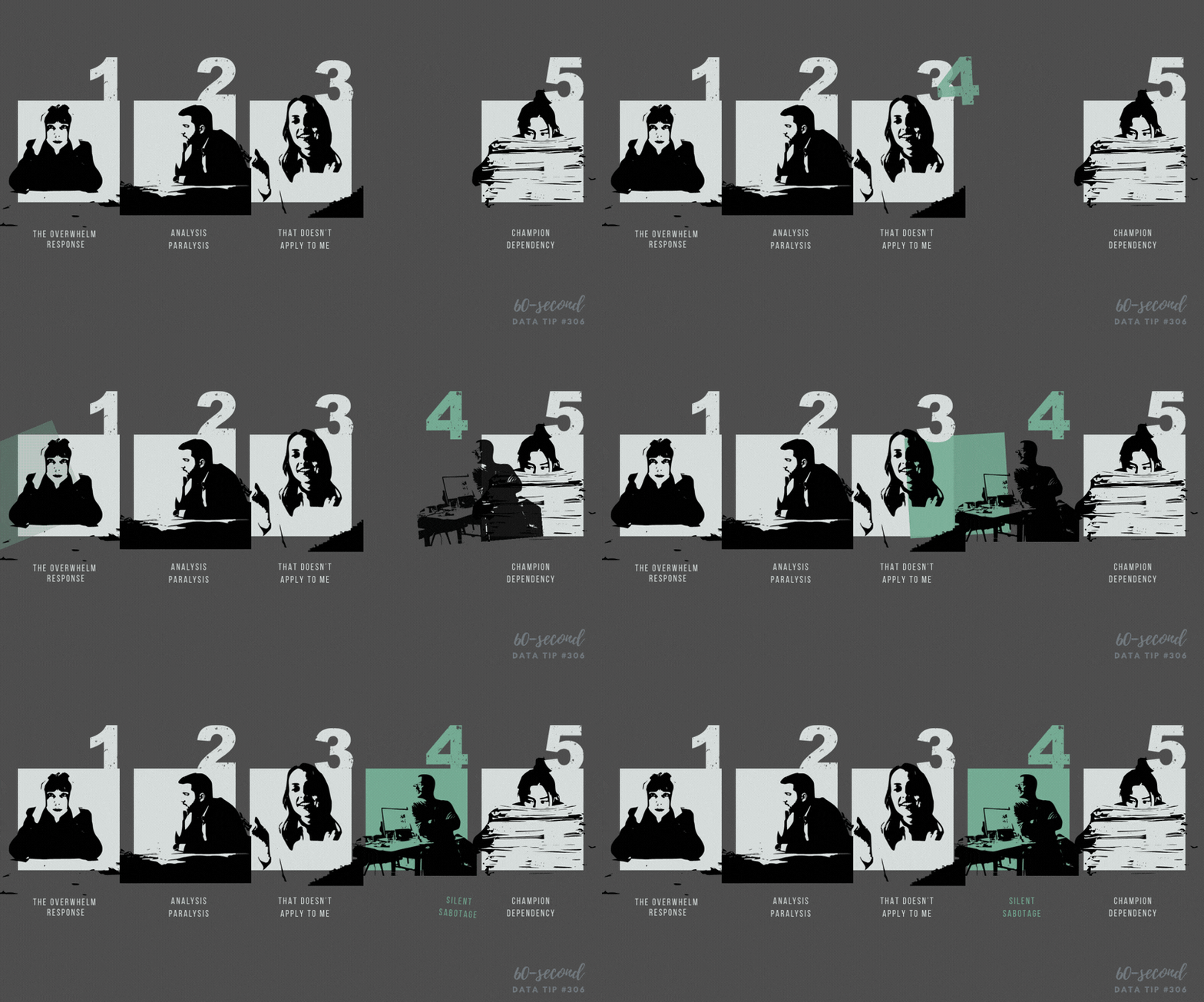
Your program director has run successful programs for ten years on instinct and relationships. Now you’re handing her a dashboard. She’s terrified she’ll ask the wrong question, or worse, misinterpret it in front of her team. So, she avoids it entirely. This is the Overwhelm Response. And it’s a common resistance pattern I see in data culture work.

The leadership move isn’t more training. It’s fewer choices. Start with one decision. One metric. One meeting. Don’t ask her to master a dashboard, ask her: “Are more people completing your program this year than last?” That’s it. One number.

Build confidence before you build complexity. Data culture doesn't start with the right system. It starts with the right question.

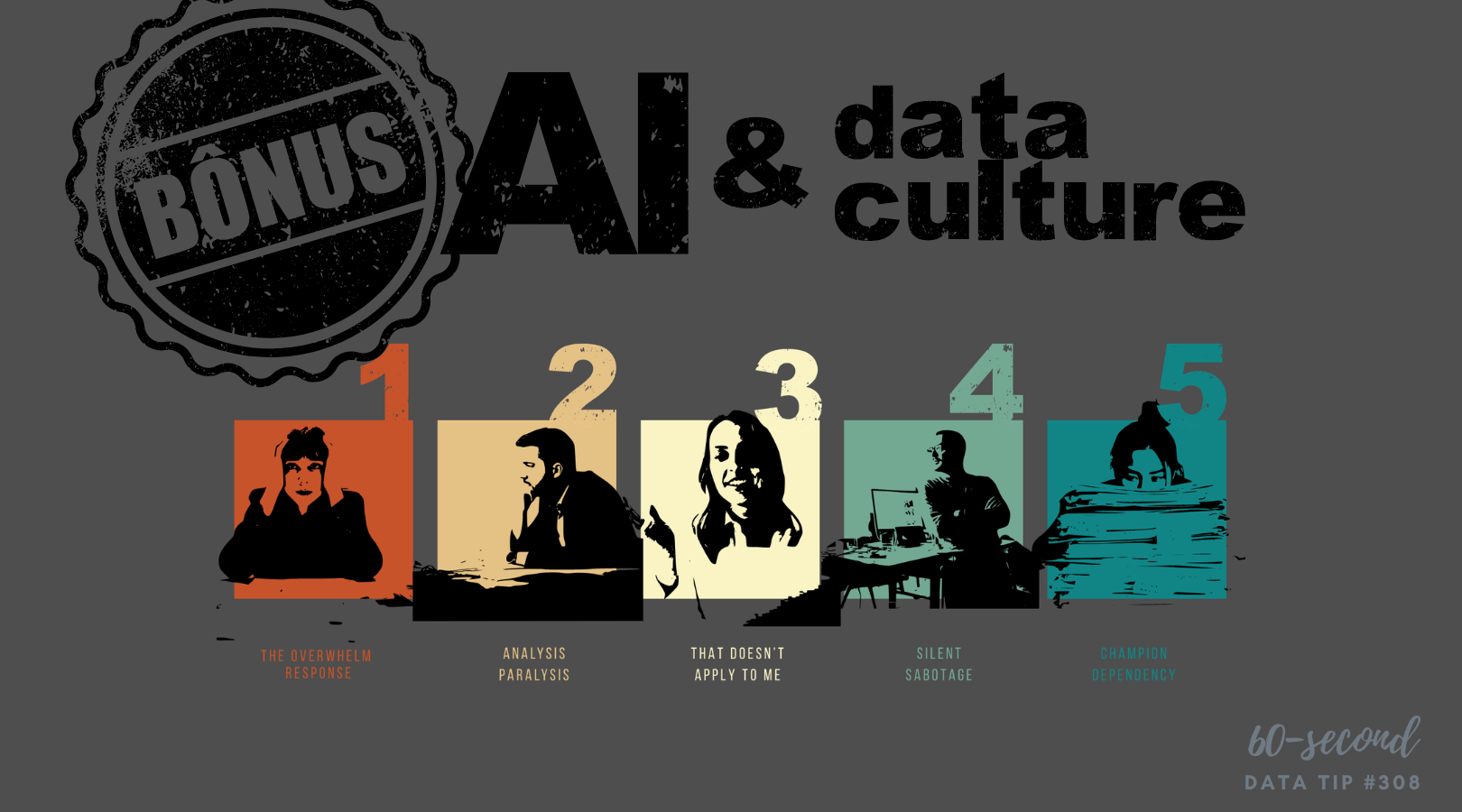
This is the first pattern in our miniseries on 5 Resistance Patterns that Kill Data Culture by Candra Reeves. (See this introduction to the series.) Follow along each week for the remaining patterns:

Pattern 1: The Overwhelm Response

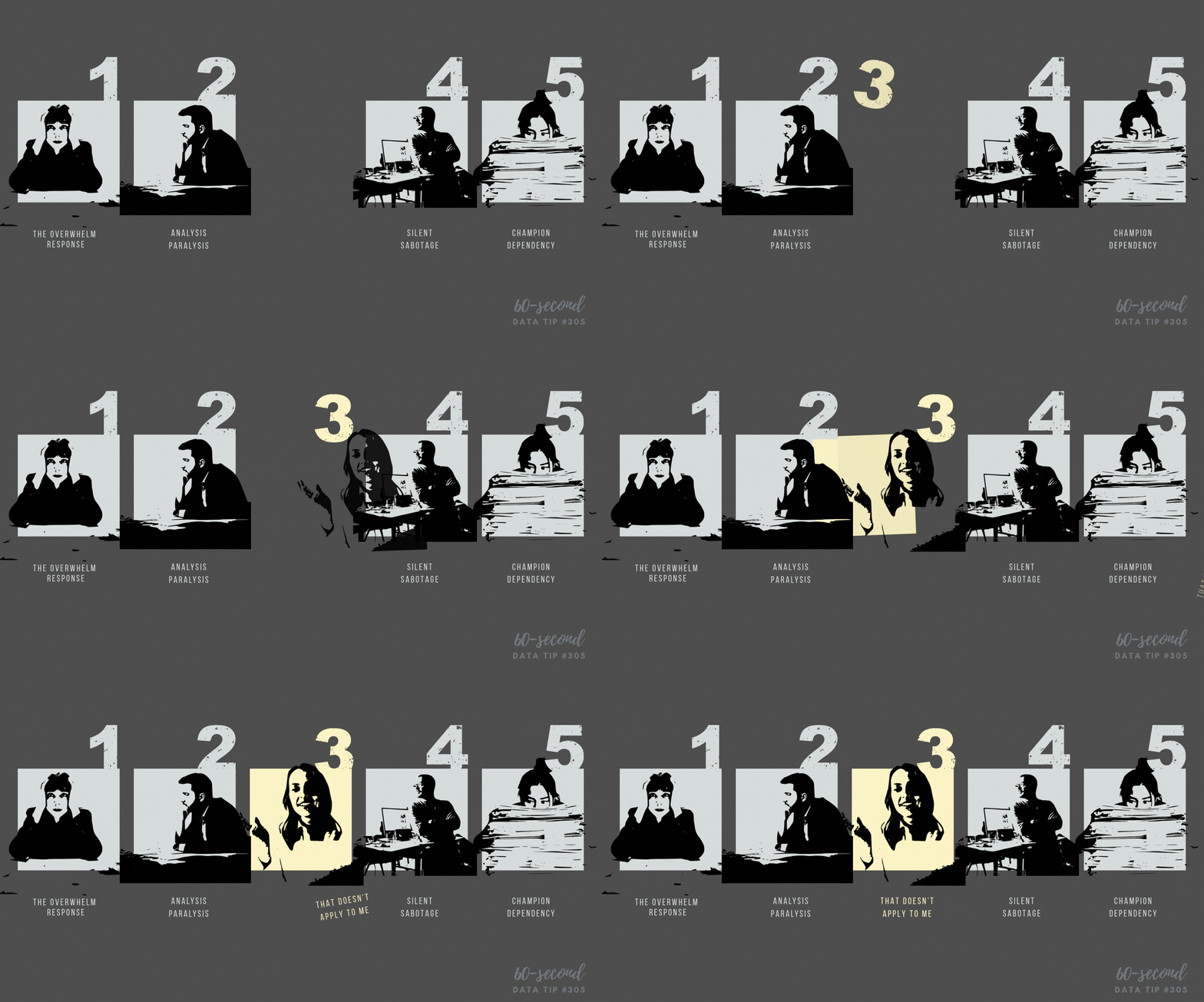
Pattern 2: Analysis Paralysis

Pattern 3: The ‘Doesn’t Apply to Me’ Response

Pattern 4: Silent Sabotage

Pattern 5: Champion Dependency


Let’s talk about YOUR data!

Got the feeling that you and your colleagues would use your data more effectively if you could see it better? Data Viz for Nonprofits (DVN) can help you get the ball rolling with an interactive data dashboard and beautiful charts, maps, and graphs for your next presentation, report, proposal, or webpage. Through a short-term consultation, we can help you to clarify the questions you want to answer and goals you want to track. DVN then visualizes your data to address those questions and track those goals.



5 Resistance Patterns That Are Killing Your Data Culture

A few weeks back, I attended a webinar with Candra Reeves. I loved how she so aptly described all the common and quite understandable reasons folks don't embrace data. And I loved her simple and clear ways of addressing those barriers. So I asked her to share her ideas in a series of 60-Second Data Tips. I'm pleased to share the first one today. -Amelia


I’m Candra Reeves, Founder & Principal of the Ardelle Group. Before launching my consultancy, I spent over a decade in the nonprofit sector. In that time, I watched well-funded data initiatives collapse. Not because the tools were bad, but because nobody addressed the human side. The resistance. The fear. The habits that outlast any dashboard or data initiative.

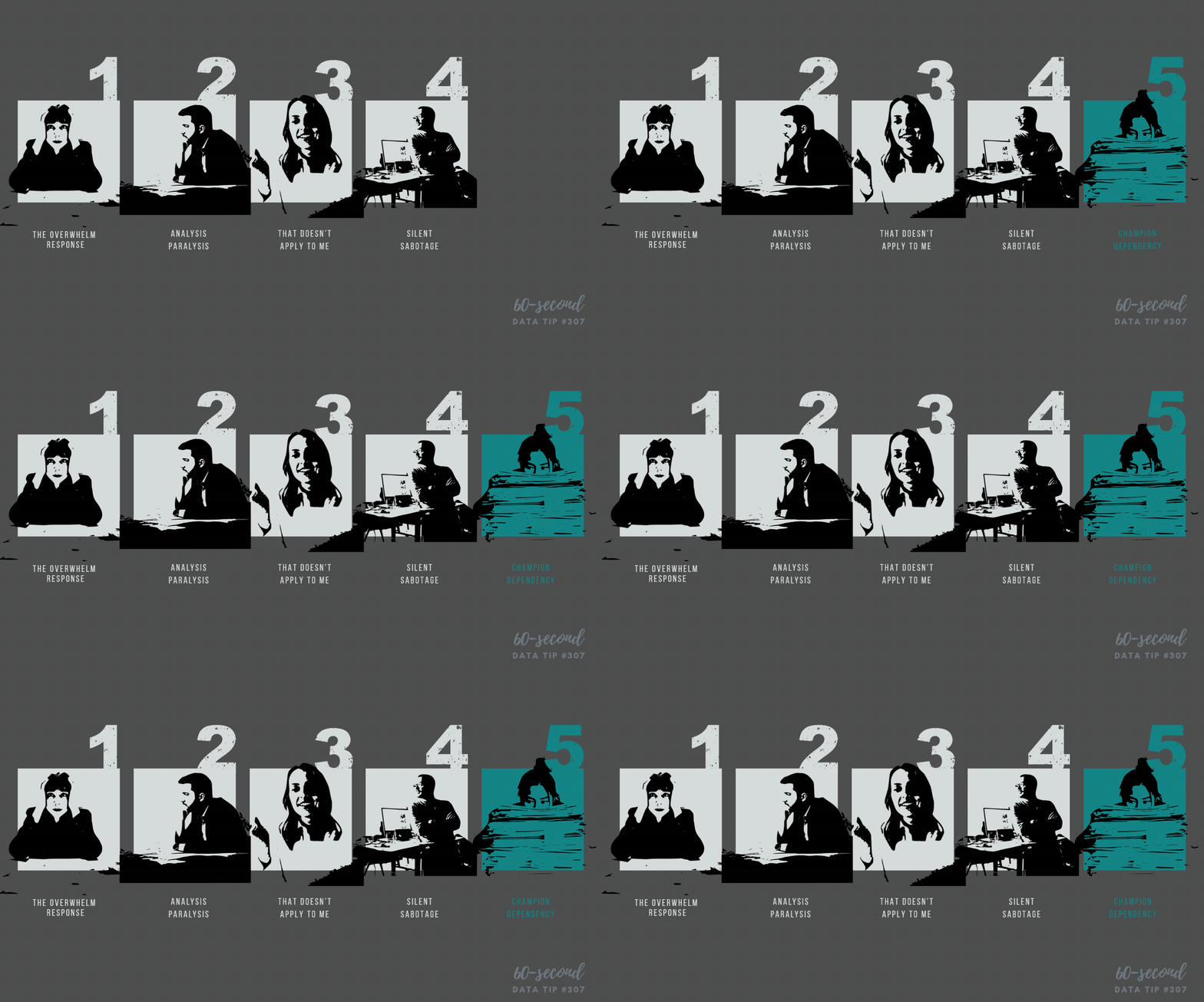
After more than 12 years of this work, I’ve identified five resistance patterns that show up in nearly every organization I work with. You’re probably experiencing at least two or three right now.

Pattern 1: The Overwhelm Response

Pattern 2: Analysis Paralysis

Pattern 3: The ‘Doesn’t Apply to Me’ Response

Pattern 4: Silent Sabotage

Pattern 5: Champion Dependency

Over the next five posts, I’m going deep on each one - what it looks like, what’s really happening underneath, and the leadership move that breaks the pattern.

Follow along each week (for the next 5 weeks) so you don’t miss a single one. And if you want to know which patterns are showing up in your organization right now, start with our free self-assessment


Let’s talk about YOUR data!

Got the feeling that you and your colleagues would use your data more effectively if you could see it better? Data Viz for Nonprofits (DVN) can help you get the ball rolling with an interactive data dashboard and beautiful charts, maps, and graphs for your next presentation, report, proposal, or webpage. Through a short-term consultation, we can help you to clarify the questions you want to answer and goals you want to track. DVN then visualizes your data to address those questions and track those goals.


What's A "Good" Survey Response Rate?

Recently, a client I’m building a data dashboard for asked me: “Our survey response rate was 30 percent. Isn’t that really good?”

I could see where she was coming from. Given how hard it is to get people to respond to surveys these days, 30 percent may feel strong—and it may be higher than what your organization typically sees.

But imagine she asked this instead: “I just bought a used car for $15,000. Isn’t that really good?” You’d probably say, “Well, it depends on the quality of the car.” If it’s a junker that can’t make it to the end of the block, it’s not a good deal.

Survey data is no different. A “good” response rate depends on the quality of the data. Rather than asking “Is my response rate good?” a more useful question is: “How representative is my survey data?” Your survey results might reflect what your clients, volunteers, or participants think and experience overall. On the other hand, they might mainly reflect the views of a small group of highly engaged, eager survey-takers.

To assess representativeness, compare your survey respondents to the larger group they’re meant to represent. Ask questions like:

  • Do respondents reflect the broader group’s demographics?

  • Are different programs, locations, or levels of participation represented?

  • Are newer participants responding at the same rate as long-time ones?

Even a high response rate can be misleading if certain subgroups are underrepresented.

If your respondents don’t look like the larger group, here’s what you can do:

1. Talk to staff and clients.

Gather insight on why certain groups may be less likely to respond. Barriers might include time constraints, language, survey length, digital access, or lack of trust in how data will be used.

2. Adjust how you collect data from underrepresented groups.

Based on what you learn, consider strategies to collect additional survey responses such as:

  • Offering the survey in multiple languages

  • Providing paper, text-based, or in-person survey options

  • Shortening the survey or breaking it into sections

  • Using trusted staff or community partners to encourage participation

  • Offering small incentives or emphasizing how feedback will be used

3. Be transparent about limitations.

Whenever you present survey results in data dashboards, presentations, your website, or social media, clarify who responded and who didn’t. For example:

“These results reflect primarily long-term program participants; newer clients were underrepresented.”

4. Apply lessons to the next survey.

Use what you learned to improve both response rates and data quality next time.


Let’s talk about YOUR data!

Got the feeling that you and your colleagues would use your data more effectively if you could see it better? Data Viz for Nonprofits (DVN) can help you get the ball rolling with an interactive data dashboard and beautiful charts, maps, and graphs for your next presentation, report, proposal, or webpage. Through a short-term consultation, we can help you to clarify the questions you want to answer and goals you want to track. DVN then visualizes your data to address those questions and track those goals.