How To Change Their Minds With Data Visualization

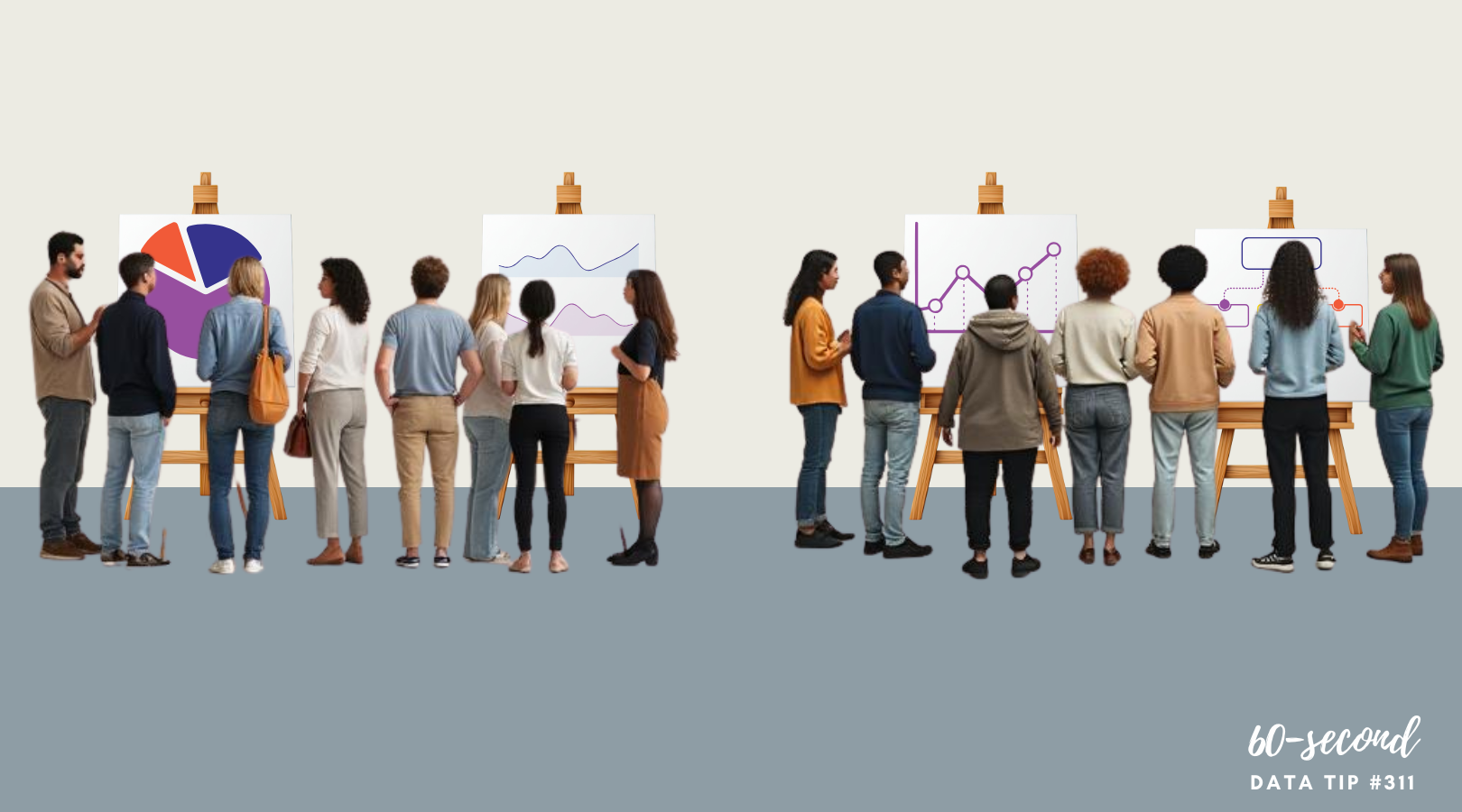
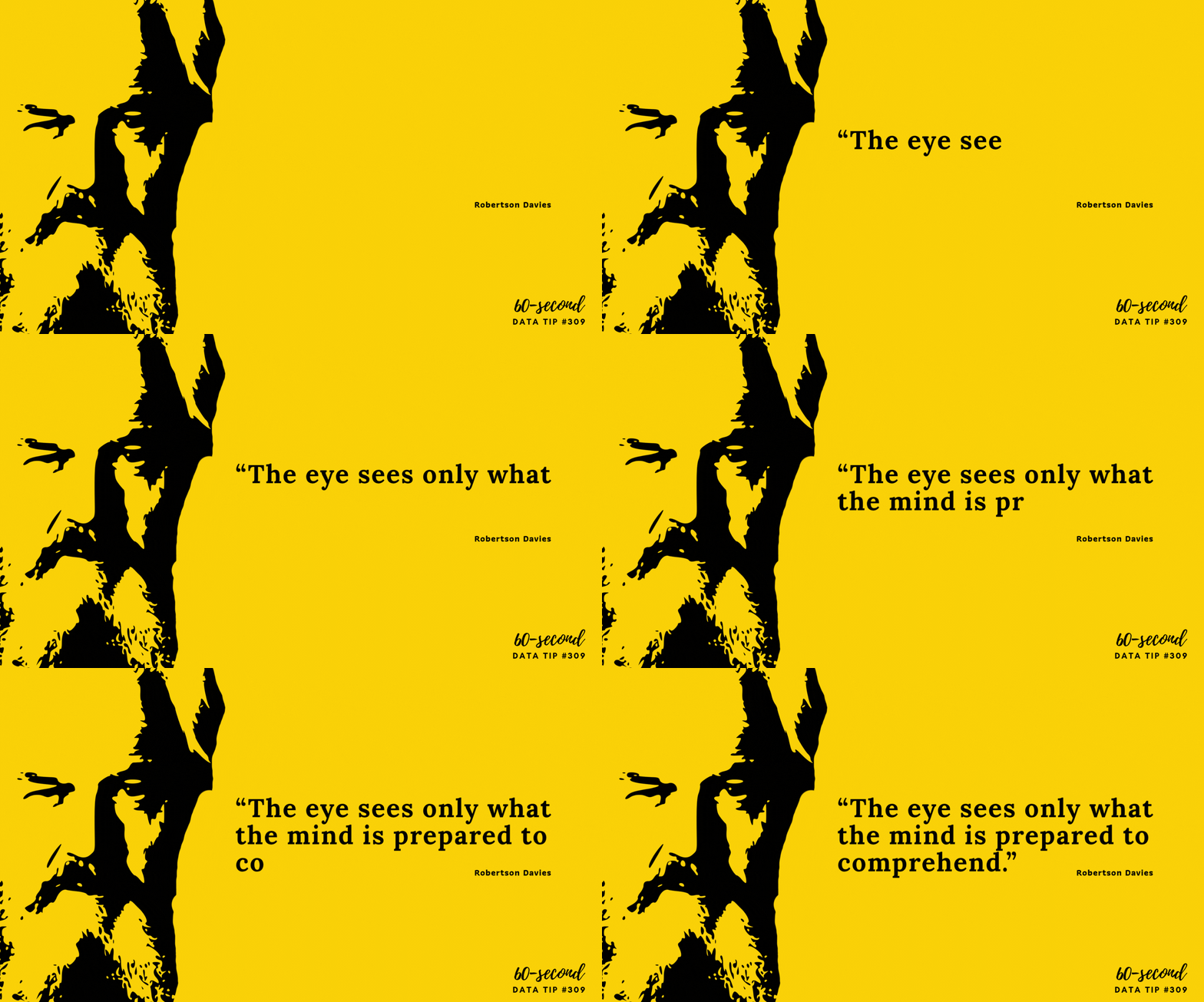
Your stakeholders aren't coming to your data as blank slates. They're arriving with assumptions, past experiences, and mental models already firmly in place. And no matter how good your visualization is, it will struggle to land if it doesn't connect to what your audience already believes.

The solution to this problem isn’t better charts. It's better bridges. Here's how to build one:

1. Start with what they already know

Open with a truth your audience already accepts such as a shared observation, a familiar trend, a problem they've personally witnessed. This isn't flattery. It's alignment. You're saying: "We're starting from the same place."

Here’s what that looks like in practice: A workforce development nonprofit is presenting job placement data to a skeptical board that believes their young adult participants are struggling primarily because they lack technical skills. So the presentation begins with: "We all know our participants come to us with significant skills gaps. That's been true since we opened our doors, and it's why our training programs exist."

2. Introduce the tension

Now show them where their current understanding falls short. Not to embarrass, but to create curiosity. "Here's what the data shows that we didn't expect." Tension is what makes people lean in.

In our example, staff might introduce tension this way: "But when we dug into why participants were leaving jobs within 90 days, technical skills almost never came up. Supervisors kept flagging something else entirely."

3. Reveal the new insight as the natural next step

Your key finding shouldn't feel like a surprise attack. It should feel like the inevitable conclusion of a journey you've taken together.

So, staff might then say: "It turns out that workplace communication and conflict resolution are often the problem. These 'soft skills' predicted job retention far better than any technical credential. Here's what that looks like in our data."

4. Anchor it in something real

Close with a specific person, community, or moment that makes the data human. Facts inform the mind. Stories open it.

In our example, that might look like this: "Marcus completed every technical module we offer. He lost his first two jobs within 60 days over a miscommunication with a supervisor. After six weeks in our new coaching program, he's been at his current job for eight months."

The most powerful nonprofit data presentations don't just show what's true. They bring their audience to the truth one step at a time.


Let’s talk about YOUR data!

Got the feeling that you and your colleagues would use your data more effectively if you could see it better? Data Viz for Nonprofits (DVN) can help you get the ball rolling with an interactive data dashboard and beautiful charts, maps, and graphs for your next presentation, report, proposal, or webpage. Through a short-term consultation, we can help you to clarify the questions you want to answer and goals you want to track. DVN then visualizes your data to address those questions and track those goals.





What's A "Good" Survey Response Rate?

Recently, a client I’m building a data dashboard for asked me: “Our survey response rate was 30 percent. Isn’t that really good?”

I could see where she was coming from. Given how hard it is to get people to respond to surveys these days, 30 percent may feel strong—and it may be higher than what your organization typically sees.

But imagine she asked this instead: “I just bought a used car for $15,000. Isn’t that really good?” You’d probably say, “Well, it depends on the quality of the car.” If it’s a junker that can’t make it to the end of the block, it’s not a good deal.

Survey data is no different. A “good” response rate depends on the quality of the data. Rather than asking “Is my response rate good?” a more useful question is: “How representative is my survey data?” Your survey results might reflect what your clients, volunteers, or participants think and experience overall. On the other hand, they might mainly reflect the views of a small group of highly engaged, eager survey-takers.

To assess representativeness, compare your survey respondents to the larger group they’re meant to represent. Ask questions like:

  • Do respondents reflect the broader group’s demographics?

  • Are different programs, locations, or levels of participation represented?

  • Are newer participants responding at the same rate as long-time ones?

Even a high response rate can be misleading if certain subgroups are underrepresented.

If your respondents don’t look like the larger group, here’s what you can do:

1. Talk to staff and clients.

Gather insight on why certain groups may be less likely to respond. Barriers might include time constraints, language, survey length, digital access, or lack of trust in how data will be used.

2. Adjust how you collect data from underrepresented groups.

Based on what you learn, consider strategies to collect additional survey responses such as:

  • Offering the survey in multiple languages

  • Providing paper, text-based, or in-person survey options

  • Shortening the survey or breaking it into sections

  • Using trusted staff or community partners to encourage participation

  • Offering small incentives or emphasizing how feedback will be used

3. Be transparent about limitations.

Whenever you present survey results in data dashboards, presentations, your website, or social media, clarify who responded and who didn’t. For example:

“These results reflect primarily long-term program participants; newer clients were underrepresented.”

4. Apply lessons to the next survey.

Use what you learned to improve both response rates and data quality next time.


Let’s talk about YOUR data!

Got the feeling that you and your colleagues would use your data more effectively if you could see it better? Data Viz for Nonprofits (DVN) can help you get the ball rolling with an interactive data dashboard and beautiful charts, maps, and graphs for your next presentation, report, proposal, or webpage. Through a short-term consultation, we can help you to clarify the questions you want to answer and goals you want to track. DVN then visualizes your data to address those questions and track those goals.