Most of us share data in ways that inform. A data walk is designed to do something more: build shared understanding and spark collective action. And unlike a presentation, it keeps everyone moving both literally and figuratively.
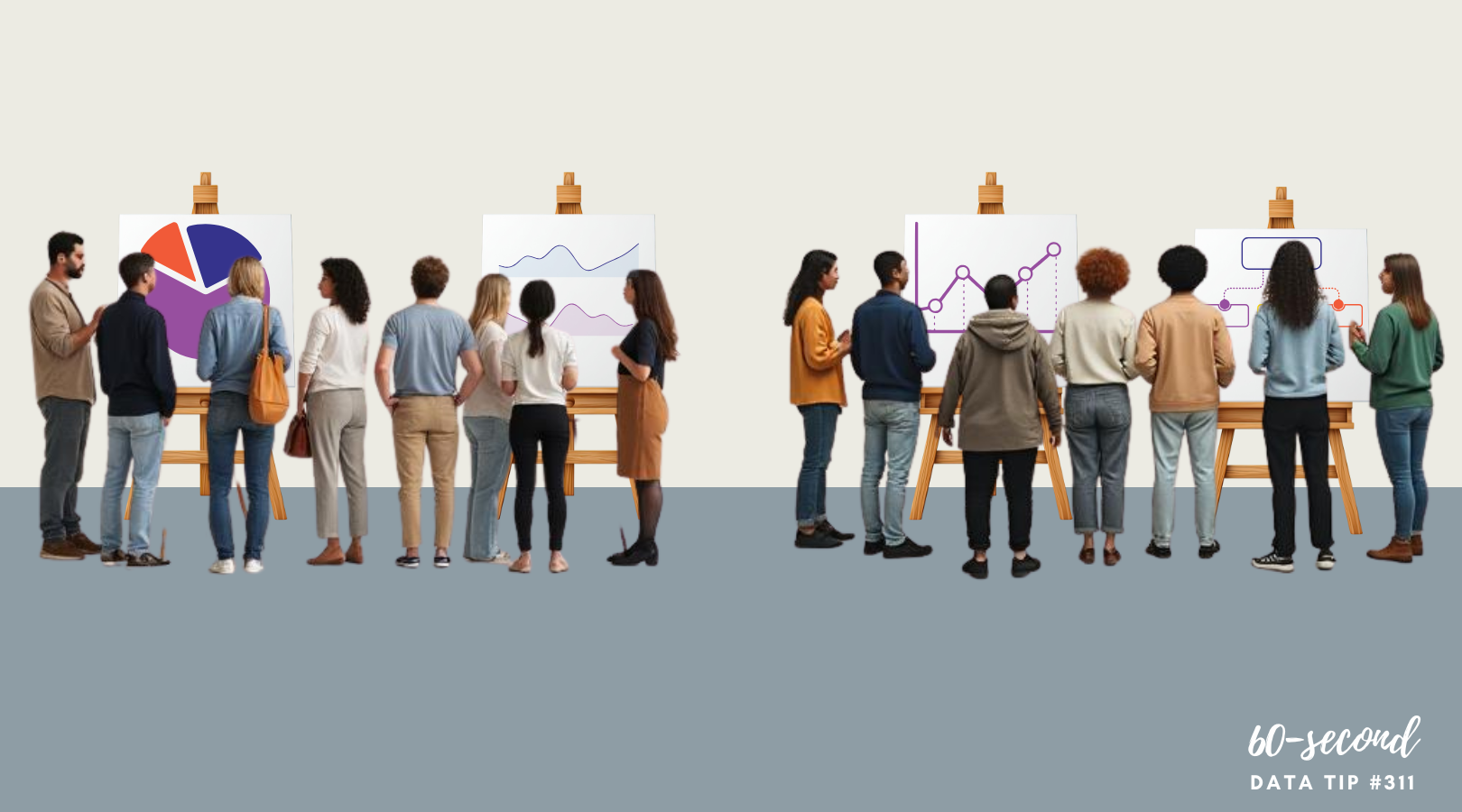
The concept, developed by the Urban Institute, is simple. You print out a small number of charts (four to six, no more), mount them around a room as stations, and invite a diverse group of stakeholders to rotate through them in small groups. The physical movement matters. There's no passive back-row seat at a data walk. Everyone is on their feet, circulating, leaning in, pointing at charts, and talking to people they might never sit next to at a traditional meeting. By the time participants finish the last station, they've traveled spatially and intellectually somewhere new.
The discussion questions do a lot of the work. Not "what does this data show?" but "what does this raise for you?" and "what factors might contribute to this?" That shift from reporting to sense-making is where the real value lies, and it's particularly well-suited to nonprofits, whose work almost always involves communities whose lived experience needs to be in the room alongside the data. A data walk creates a rare level playing field where a longtime resident and a program director are both analysts, both contributing, both learning.
And the charts themselves matter enormously. Because each station needs to communicate quickly and spark conversation rather than settle it, your visualizations need to be clear, focused, and simple enough that a mixed audience can engage with them without explanation.
Rockford, Illinois used this approach in 2018 to mobilize their community around third grade reading. Eighty people showed up. People who came in thinking the problem had an obvious fix left with a much more nuanced understanding of why it didn't. That's the data walk at its best: not a presentation of answers, but a structured journey toward better questions.
Learn more: Rockford's Data Walk on 3rd Grade Reading by Sylvia Cheuy, Tamarack Institute.
Let’s talk about YOUR data!
Got the feeling that you and your colleagues would use your data more effectively if you could see it better? Data Viz for Nonprofits (DVN) can help you get the ball rolling with an interactive data dashboard and beautiful charts, maps, and graphs for your next presentation, report, proposal, or webpage. Through a short-term consultation, we can help you to clarify the questions you want to answer and goals you want to track. DVN then visualizes your data to address those questions and track those goals.